Seven Frequently Asked Questions about Helical Piles
Explore seven frequently asked questions about helical piles, covering design life, soil conditions, load capacity, obstructions, and seismic performance.
Helical piles are a proven deep foundation solution used across commercial, industrial, utility, and infrastructure applications. Despite their long history and widespread use, questions often arise regarding helical pile design, installation, capacity, lifespan, and performance in varying soil and seismic conditions. This FAQ addresses some of the most commonly asked questions about helical pile foundations, drawing on industry standards, research, and practical field experience to help engineers, contractors, and owners make informed foundation decisions.
1. What’s the average life expectancy of a helical pile?
From a practical standpoint an engineer can expect a typical service life expectancy of a helical pile to be 75 to 100 years. This is highly dependent on the corrosive protentional of the site and in-situ soil resistivity. The rate of corrosion can be reasonably estimated using site-specific information about the soil’s electrochemical properties. When this data is available, the pile can be designed to account for anticipated steel or galvanizing loss over the project’s design life. In the absence of site-specific corrosion data, conservative assumptions for corrosion rates are commonly used when selecting pile type and size. This ensures sufficient remaining steel cross-sectional area is available to safely support the required design loads throughout the intended design life.
In special circumstances where loss rates of steel or galvanizing are not sufficient to yield the service life expectancy required additional carrion protection such as marine grade coatings, coal tar epoxy, tape coat, or cathodic protection may be added to extend the life expectancy of a helical pile.
Helical piles are considered a permanent foundation solution. Their service life depends on soil corrosion conditions and design assumptions, but with proper corrosion allowances, they can meet or exceed the project’s intended design life.
Learn more about helical pile capacity over time.
2. Can helical piles be installed in any type of soil?
Helical piles perform best when they can be bear upon medium-to-dense soils , including very dense soils and weathered rock. They are not intended to penetrate competent bedrock.
While helical piles can be installed in many soil types, their performance depends on achieving adequate bearing conditions at the helix plates. A site-specific geotechnical evaluation is recommended to confirm suitability.
Here is a table of soil classes and general recommendations for the use of helical piles.
|
Soil Class |
Common Soil-Type Description |
Geological Soil Description |
Typical Blow Count "N" Per ASTM-D 1586 |
Recommendations
|
|
0 |
Sound hard rock, unweathered |
Granite, basalt, massive limestone |
N.A. |
Do not use helical piles |
|
1 |
Very dense and/or cemented sands; coarse gravel and cobbles |
Caliche, (nitrate-bearing gravel/rock) |
60-100+ |
Use ROCK-IT lead section. Square shaft extensions will provide best penetration. |
|
2 |
Dense fine sands; very hard silts and clays (may be preloaded) |
Basal till; boulder clay; caliche; weathered laminated rock |
45-60 |
Use ROCK-IT lead section. Square shaft extensions will provide best penetration. |
|
3 |
Dense sands and gravel; hard silts and clays |
Glacial till; weathered shales, schist, gneiss and siltstone |
35-50 |
Use Square Shaft (SS) lead section. Extensions may be pipe or square shaft. |
|
4 |
Medium dense sand and gravel; very stiff to hard silts and clays |
Glacial till; hardpan; marls |
24-40 |
Use Square Shaft (SS) lead section. Extensions may be pipe or square shaft. |
|
5 |
Medium dense coarse sands and sandy gravels; stiff to very stiff silts and clays |
Saprolites, residual soils |
14-25 |
Pipe or square shaft helical anchors may be used |
|
6 |
Loose to medium dense fine to coarse sands to stiff silts and clays |
Dense hydraulic fill; compacted fill; residual soils |
7-14 |
Any helical pile shaft type may be used |
|
7 |
Loose fine sands; Alluvium; loess; medium - stiff and varied clays; fill |
Flood plain soils; lake clays; adobe; gumbo, fill |
4-8 |
Any helical pile shaft type may be used |
|
8 |
Peat, organic silts; inundated silts, fly ash very loose sands, very soft to soft clays |
Miscellaneous fill, swamp marsh |
0-5 |
Not suitable as a bearing layer |
With a tough carbide tip, the Chance ROCK-IT® lead section was designed for dense, rocky, high blow count, and permafrost soils. Learn more about ROCK-IT.
Helical piles are especially effective in poor or variable soils because they transfer load to deeper, more competent strata. Shallow foundations, like concrete, rely on near‑surface soils, which may require over‑excavation or ground improvement if conditions are unfavorable.
3. What are the best methods for handling obstructions with helical piles?
Ideally, subsurface obstructions are infrequent on a project site. When they do occur, several mitigation options may be available:
- Relocating the affected pile
- Installing the pile on a batter (at an angle) to avoid the obstruction
- Removing near-surface obstructions through excavation
- Pre-drilling through problem zones when appropriate
If an isolated obstruction is encountered during installation, load testing the affected pile can also be considered to verify that its load-supporting capability has not been compromised. One benefit of helical piles is that an obstruction doesn’t mean you have to abandon the pile. Unlike some other deep foundations, in most cases, the pile can be removed and reinstalled.
4. Do helical piles provide both compression and tension capacity?
Yes. Helical piles can be designed to resist both compression and tension loads. They are typically supplied with pile terminations (such as new construction caps) capable of accommodating compression loads, tension loads, or a combination of both.
Because helical piles derive their axial capacity from bearing at the helix plates, they often develop the same, or very similar, resistance in both compression and tension, provided soil conditions and installation criteria are consistent. When helical piles are subjected to reversing tension and compression loads, total gross pile deflection must be considered as part of the serviceability evaluation.
Due to normal manufacturing tolerances associated with bolted pile couplings, a small amount of connection slack exists within each joint. This coupling slack can contribute approximately 1/16 to 1/8 inch of additional axial displacement per connection, increasing the overall gross displacement of the pile under load. For flexible structures, this additional movement generally does not adversely affect serviceability. However, for rigid or deflection‑sensitive structures, coupling shims or grouting may be required to stiffen the load–deflection response and reduce measurable movement at service loads.
By using the Chance software HeliCAP, helical capacity design software, you can calculate the capacity of your pile using soil borings from the jobsite. Sign up for a free account today!
5. How do helical piles perform in a seismic or liquefaction event?
Helical piles are end-bearing elements, and when properly designed, their axial capacity is not expected to be adversely affected by seismic events. In seismic regions where liquefaction is a concern, helical piles are typically designed to bear in soils or strata below liquefiable layers and shafts are designed to resist column buckling.
Read about a seismic design project with helical piles.
Helical piles can also contribute to a structure’s lateral capacity through passive soil resistance or by using battered pile configurations, particularly when liquefied or post‑seismic soil conditions are assumed. Piles relying on passive resistance depend heavily on soil strength and are typically only effective for relatively small lateral loads, although testing has shown steel shafts can provide some damping of seismic vibrations.
Battered helical piles can resist much higher lateral loads, but they also stiffen the overall pile group and pile cap response. Structural engineers often assume that pile caps will deflect similarly to the surrounding soil during peak ground acceleration. When battered piles are used, this assumption may not hold true, as the increased stiffness can locally amplify acceleration and increase lateral demand on the piles. For this reason, it is important that structural engineers understand the resulting stiffness of the entire foundation system when battered helical piles are used.
In June 2020, the International Code Council Evaluation Service (ICC-ES) formally recognized the use of helical piles in Seismic Site Classes A through F in Acceptance Criteria AC358, further acknowledging their suitability in seismic applications when properly designed. See all Chance Building Code Evaluated products.
6. Can compression/tension helical pile be installed on an angle (batter) to resist lateral loading?
Yes. Helical piles can be installed on a batter and are generally most effective when installed at angles of 45 degrees or less from vertical. Battered helical piles are often installed in opposing pairs to resist lateral loads acting along the same plane as the pile pair. This is particularly important for smaller‑diameter piles, which should not be assumed to behave as perfectly rigid elements.
Best practice is to align opposing pile pairs at an angle and spacing that follow the resultant vector of combined compression, tension, and lateral loads. As a general tip, pile heads should be spaced closer to the line of action of the applied loads for shear‑controlled lateral behavior and spaced farther apart when lateral resistance is governed by overturning moment.
7. How long have helical piles been around, and how have they historically been used?
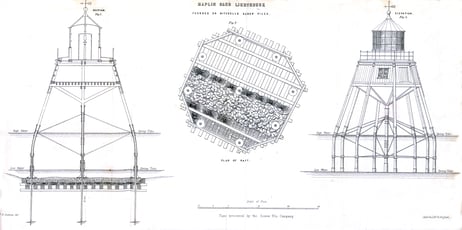 Helical piles have a long history. In 1833, English inventor Alexander Mitchell patented what was then known as the “screw pile.” One of the earliest applications was supporting lighthouses in tidal basins throughout England. The technology was soon adopted in the United States, including for lighthouse foundations along the coasts of Maryland, Delaware, and Florida.
Since then, both academic research and commercial development have advanced the design and application of helical piles and Anchors. Significant research has been performed or supported by CHANCE—formerly the A.B. Chance Company—a brand of Hubbell Power Systems, Inc. Today, Hubbell continues to provide financial, material, and engineering support for ongoing research into helical pile technology.
These FAQs reflect commonly asked questions during the design and installation of helical pile foundation systems. As with any deep foundation solution, site-specific geotechnical conditions and project requirements should always guide final pile selection and design. Please contact civilconstruction@hubbell.com or reach out directly to engineering and product experts at your local Chance distributor.
Recommended Posts
Built to Last: Proven Longevity & Corrosion Resistance of Steel Foundations
Going Solo: Load Improvement of Single-Helix Anchors and Piles