We’re All Getting Older! Aging Behavior of Helical Anchors and Piles
Helical piles often gain significant load capacity over time—meaning many designs leave unused strength in the ground.
One of the advantages often given for using helical anchors or piles is that they can be used immediately after installation. That is, they develop load capacity on installation. This can be a great advantage on some projects where load needs to applied on an anchor or pile quickly, such as in an emergency repair of a wall, foundation or slope. But what happens over time? Is there a change in load capacity as the pile sits?
It is not uncommon for some projects to include load tests immediately or shortly after installation to provide on-site correlations between ultimate capacity and installation torque. Engineers may assume that a load test conducted soon after installation would provide the lowest ultimate capacity and that longer periods of rest will result in higher capacity. This may also be considered as a conservative approach to design but may leave unused load capacity, which may be uneconomical to the owner. On the other hand, some projects may require that load be applied shortly after installation such as in disaster relief situations or rapid construction schedules.
It has been well established in the past 70 years that the load capacity of driven piles often shows an increase with time after driving, especially in saturated fine-grain soils. This is partly because of the dissipation of excess pore water pressure created during driving (set-up) and partly because of the increase in shear strength (aging) of the remolded soil which is a thixotropic characteristic of many clays. It is also well known that driven piles in many sands may also show an increase in load capacity with time, although the mechanisms for this behavior are different than for clays. This behavior may be exhibited for some helical anchors and piles depending on the soil conditions.
The aging behavior of helical piles was well recognized by early engineers and observed in the late 19th century by Murray (1884) who described the behavior of helical piles installed for a quay:
“While putting down the piles for the quay, it was observed that they did not attain anything like their full bearing power until after standing untouched for 30 to 40 hours. In some cases where they had been sunk 25 or 30 feet, and loaded immediately after, they began gradually to sink with a weight of 8 to 9 tons; whereas, in similar cases, when allowed to stand 30 hours, they bore 30 tons without the slightest indication of sinking. From this it would appear that while the pile is being sunk, the flanges in its shaft, and more particularly the screw in their passage downwards disturbs the ground so much that the piles cannot be said to have attained its ultimate bearing power until a sufficient time for the earth to close up and exert its full side pressure around the shaft.
This is also borne out in the screwing of the permanent piles, for as long as they are being turned, a force equal to 15 men at the end of a 12 feet lever was generally sufficient to screw them to their bearing. If, however, a pile had not reached its destination before night came on, and was allowed to remain till morning, it was with the greatest difficulty that it could be again started even by applying three times the usual power. On one occasion it was all that 36 men could do, jerking as hard as they could, to move a pile that had been standing for some time.”
Murray’s observations suggest that a simple way to check the aging behavior would be to perform “re-torque” tests at different periods of time after installation on an accessible anchor or pile.
Wilson (1950) also noted that increases in load capacity of helical piles in clay over time could be attributed to regain of shear strength caused by disturbance during installation, noting that:
“In the case of cohesive soils, the remoulding action of the screw seems certain to weaken the soil traversed by the blade. A certain amount of its original strength will no doubt be re-established by re-compaction [reconsolidation] under its own weight in the course of time. If the nose of the pile is closed, remolding may extend to a greater radius due to its displacement of soil by the shaft. The effect of such remoulding of the soil around the shaft would appear likely to be that the initial bearing capacity of the pile would be limited to that of the blade, adhesion on the shaft coming into play only as the soil reconsolidates.”
These descriptions of the increase in capacity with aging of helical piles in clay suggest that the primary mechanism for capacity increase is the increase in shear strength that occurs sometime after initially being disturbed by the installation, i.e. thixotropy. However, based on many observations and studies of driven piles in clays, especially soft and very soft clays, it is now well known that both thixotropy and the dissipation of excess pore water pressures from driving may help the aging process.
The load capacity of helical piles and anchors is developed from two components, helix capacity and shaft capacity. The distribution of total load capacity between the helix or helices and shaft depends on the soil and the geometry of the pile, i.e., diameter and length of the central shaft and diameter, spacing and number of helices. Only the portion of the shaft in full contact with the adjacent soil, usually the lead section, develops shaft capacity.
There are no known published results evaluating aging behavior of helical anchors or piles in either compression or tension in different soils. Chance Civil Construction has conducted field tests of helical anchors in both clay and sand and from these tests, behavior in compression can be inferred.
Aging in Clay
Weech & Howie (2012) showed that in sensitive silty clay in British Columbia, Canada a round-shaft multi-helix pile showed no increase in capacity after aging from 19 hours to 7 days. Zhang et al. (2017) showed that the axial uplift capacity of 1g model round-shaft single-helix anchors embedded in very soft Ariake clay from Japan increased considerably for the first 30 days after installation but then leveled off. The increase in capacity was largely attributed to the thixotropic behavior of the clay. Lanyi-Bennett & Deng (2019) showed that in stiff clay in Canada helical anchors showed no increase in axial uplift capacity after aging for from 2 hours to 15 days after installation. These studies had relatively short aging periods may not have captured the behavior for long-term aging.
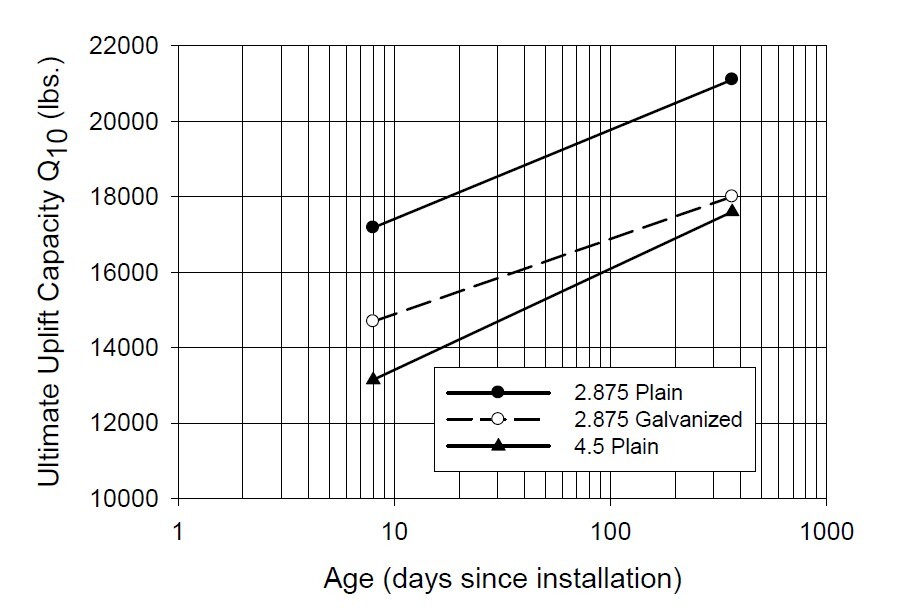
Fig. 1 shows tests on round-shaft single-helix anchor piles in stiff clay in Hadley, Ma. Two shaft diameters were installed and tested (2.875 in. and 4.5 in.) both with a single 14 in. helix, embedded at a depth of 9 ft. Both anchors were fabricated from plain uncoated steel and the shafts were one piece, i.e., no extensions. In addition, an identical 2.875 in. galvanized helical anchor pile was installed at the same time. Tests were initially performed 8 days after installation and then repeated after 370 days. The increase in capacity is clear for all three anchors. The ratio of initial to final load capacity is:
2875 Plain Q/Q0 = 1.23
450 Plain Q/Q0 = 1.34
2875 Galvanized Q/Q0 = 1.23
Interestingly, the larger diameter anchor pile shows lower capacity than the smaller anchor. Even though the larger shaft has more surface area, the helix area in uplift is smaller for the larger anchor because of the larger diameter shaft. The tradeoff of increased shaft capacity is offset by the reduction in helix capacity in uplift. As expected, the galvanized anchor shows less capacity that the plain anchor of the same diameter because of the smoother shaft surface. Even though it showed an increase in capacity with time, this was most likely caused by the increase in helix capacity as the clay above the helix gained shear strength.
Figure 1. Aging Behavior of Helical Anchor Piles in Clay.
Two straight pipe piles were also installed and tested in tension at the same times as the helical piles. These tests are shown in Fig. 2. Of course, the larger diameter pile shows a higher load capacity. Putting these two sets of tests together, the change in uplift capacity of the helical piles can largely be attributed to both the increase in shaft and helix resistance for the smaller pile but almost exclusively to the increase in shaft resistance for the larger pile.
Figure 2. Aging Behavior of Straight Piles in Clay.
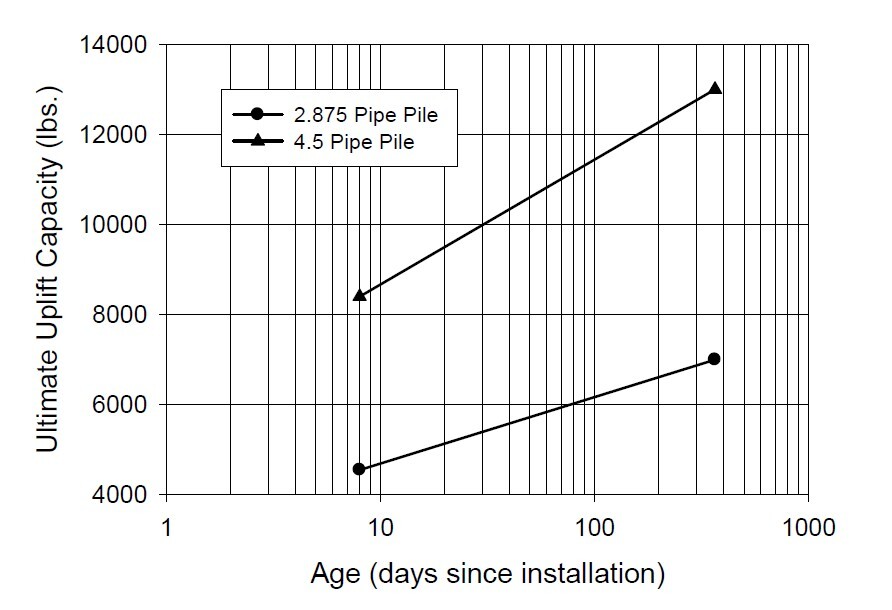
Figure 3 shows results of another set of tension tests performed on 5 individual round-shaft (DS = 2.875 in. (730 mm)) triple-helix (8/10/12) anchors installed to a depth of 25 ft. in very stiff clay in Centralia, Mo. The axial load capacity at displacements of 5% and 10% of the helix diameter are shown for comparison of the behavior at different levels of loading. There is little difference in Q10 values up to 10 days but then a clear increase in capacity after 10 days. Naturally, it shouldn’t be expected that any increase will continue forever, but should level off at some point. The ratio of initial to final load capacity is Q/Q0 = 1.25.
Figure 3. Aging Behavior of Round-Shaft Multi-Helix Anchors in Very Stiff Clay.
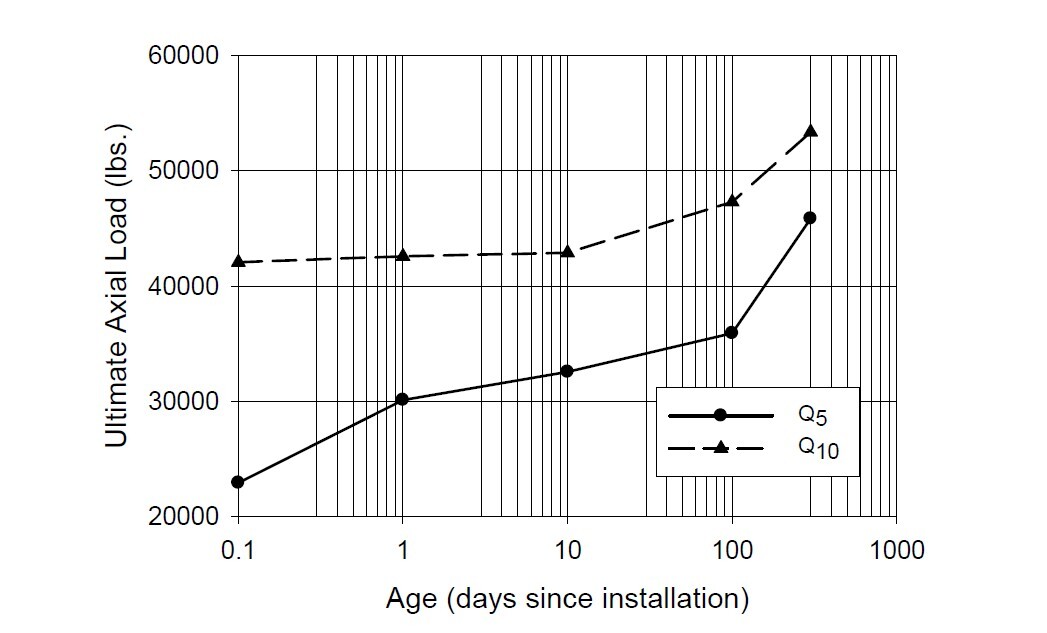
So far, the results suggest that, like many driven piles, there may be unused load capacity as a result of aging that the engineer is not considering. This increase in load capacity is likely developed both in the shaft and in the helical plate(s) and may represent the increase in undrained shear strength after recovery after partial remolding from installation and additional aging.
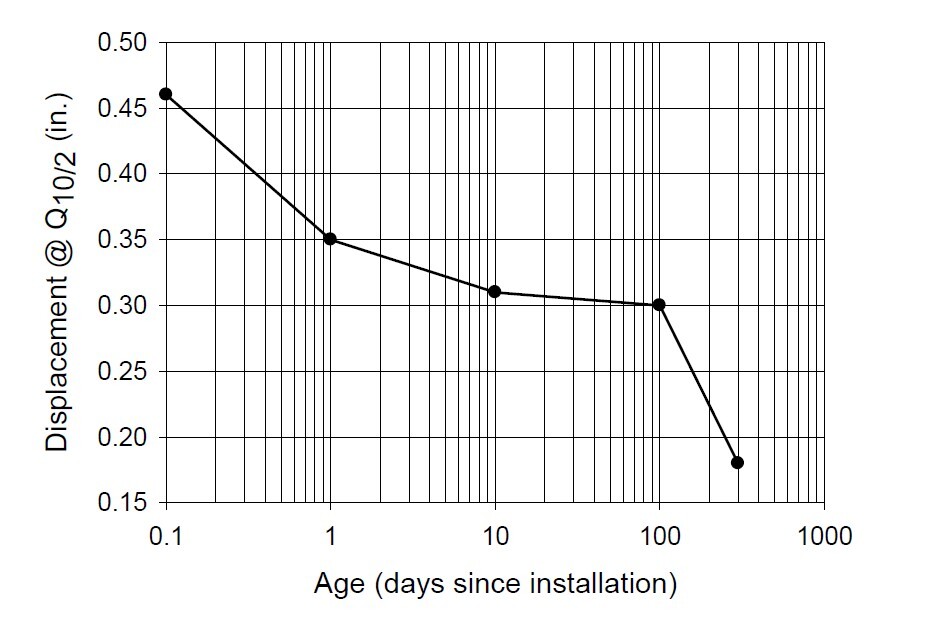
Figure 4 shows the measured displacement at a load level of Q10/2, which is often used as a serviceability load. These results suggest that in addition to gaining load capacity with time, the stiffness of the anchors also increased with aging.
Figure 4. Aging Effect on Displacement at Serviceability State (Q10/2).
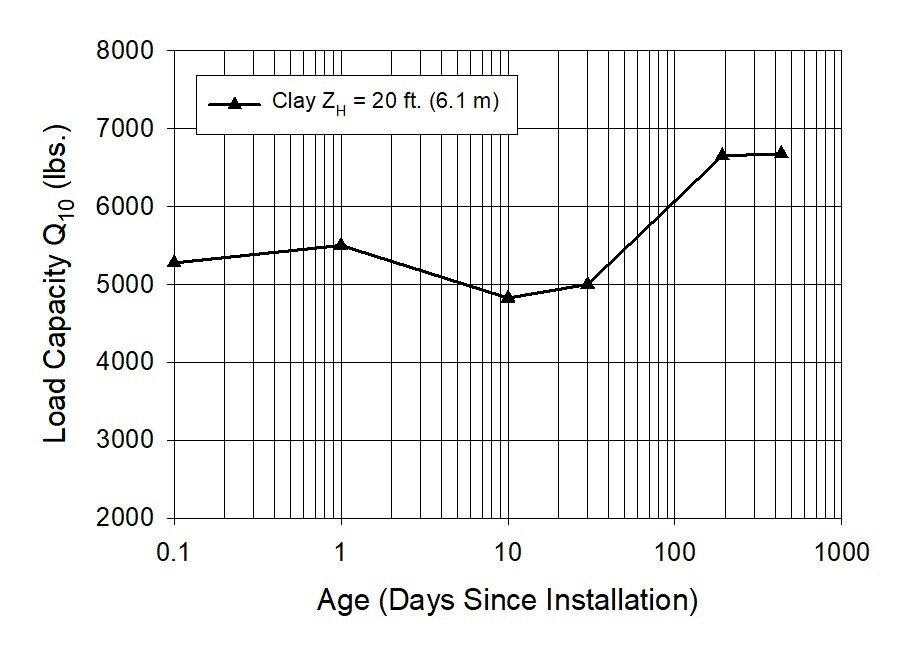
In clays the increase in load capacity with time may depend on both the soil composition and state as well as the specific geometry of the anchor or pile. Since there may be more disturbance of the soil from multi-helix geometries, one might expect more recovery of strength over time as compared to a single-helix. Figure 5 shows the axial capacity of a set of 6 square-shaft (1.5 in. x 1.5in. (38 mm x 38 mm)) (DH = 12 in. (305 mm)) anchors installed in medium stiff clay in Deerfield, Ma. There is no gain in capacity up to about 20 days (actually a slight decrease) and then an increase up to 300 days. The ratio of initial to final capacity is Q/Q0 = 1.3.
Figure 5. Aging Behavior of Square-Shaft Single-Helix Anchors in Clay.
An increase in load capacity with aging would only be expected if the soil engaged by the helical plates under loading has sufficient thixotropic properties that produce an increase in undrained shear strength. As shown by several studies, thixotropic behavior of clays at constant water content depends on both soil characteristics and soil state, e.g., Liquidity Index. For round-shaft helical anchors and piles in both stiff and soft clay, an increase in axial capacity should be expected with aging, mostly related to an increase in shaft resistance. For square-shaft anchors and piles in clay, very little aging is expected but in sands, there may be some increase as sand moves back into the open cavity over time.
Aging in Sand
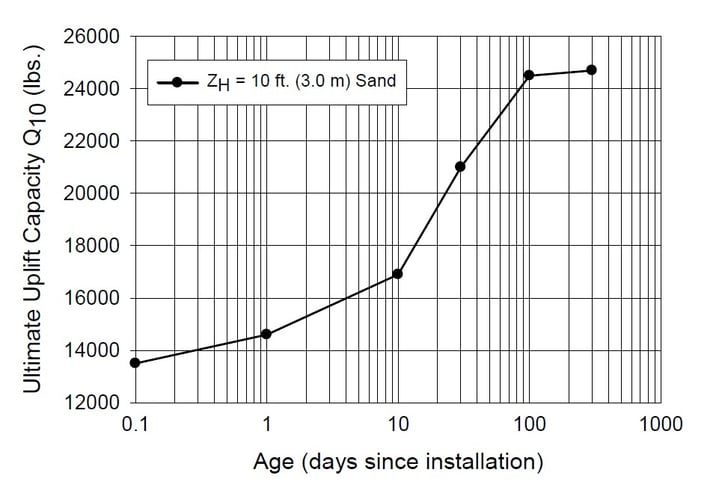
Driven piles in sand also show aging behavior although the mechanisms for the increase in load capacity are different than in clay. Figure 6 shows the axial capacity of a set of 6 square-shaft (1.5 in. x 1.5 in. (38 mm x 38 mm)) (DH = 12 in. (305 mm)) anchors installed in medium dense sand in Deerfield, Ma. These tests show quite a dramatic increase in load capacity after 10 days. The ratio of final to initial capacity Q/Q0 = 1.8. In this case, the increase in capacity is likely to be the result of increase helix capacity and possibly some shaft capacity as the sand refilled the cavity next to the shaft.
Figure 6. Aging Behavior of Square-Shaft Single-Helix Anchors in Sand.
When Might Aging of Helical Anchors and Piles be Expected?
In general, there is substantial evidence to expect an increase in load capacity of helical anchors and piles over time for most (but not all) situations. For example, square-shaft helical piles loaded in compression will likely show no significant increase. The degree of increase depends largely on the nature of the soil conditions. Other situations involving round-shaft helical anchors or piles in both tension and compression will likely show some aging. In clays aging depends on initial stiffness, strength and Sensitivity; in sands aging depends on initial Relative Density. Long-term aging is likely to be greater for plain, uncoated anchors and piles as compared to galvanized anchors and piles. More work is needed to allow the engineer to consider taking advantage of unused load capacity.
Dr. Alan Lutenegger is Emeritus Professor of Geotechnical Engineering at the University of Massachusetts-Amherst. He has over 45 years of experience in geotechnical engineering and over 20 years of practical experience with helical anchors and piles.
Recommended Posts
Built to Last: Proven Longevity & Corrosion Resistance of Steel Foundations
Going Solo: Load Improvement of Single-Helix Anchors and Piles