This article breaks down four frequent misconceptions about underground residential distribution (URD) temporary grounding and explains the facts behind each one.
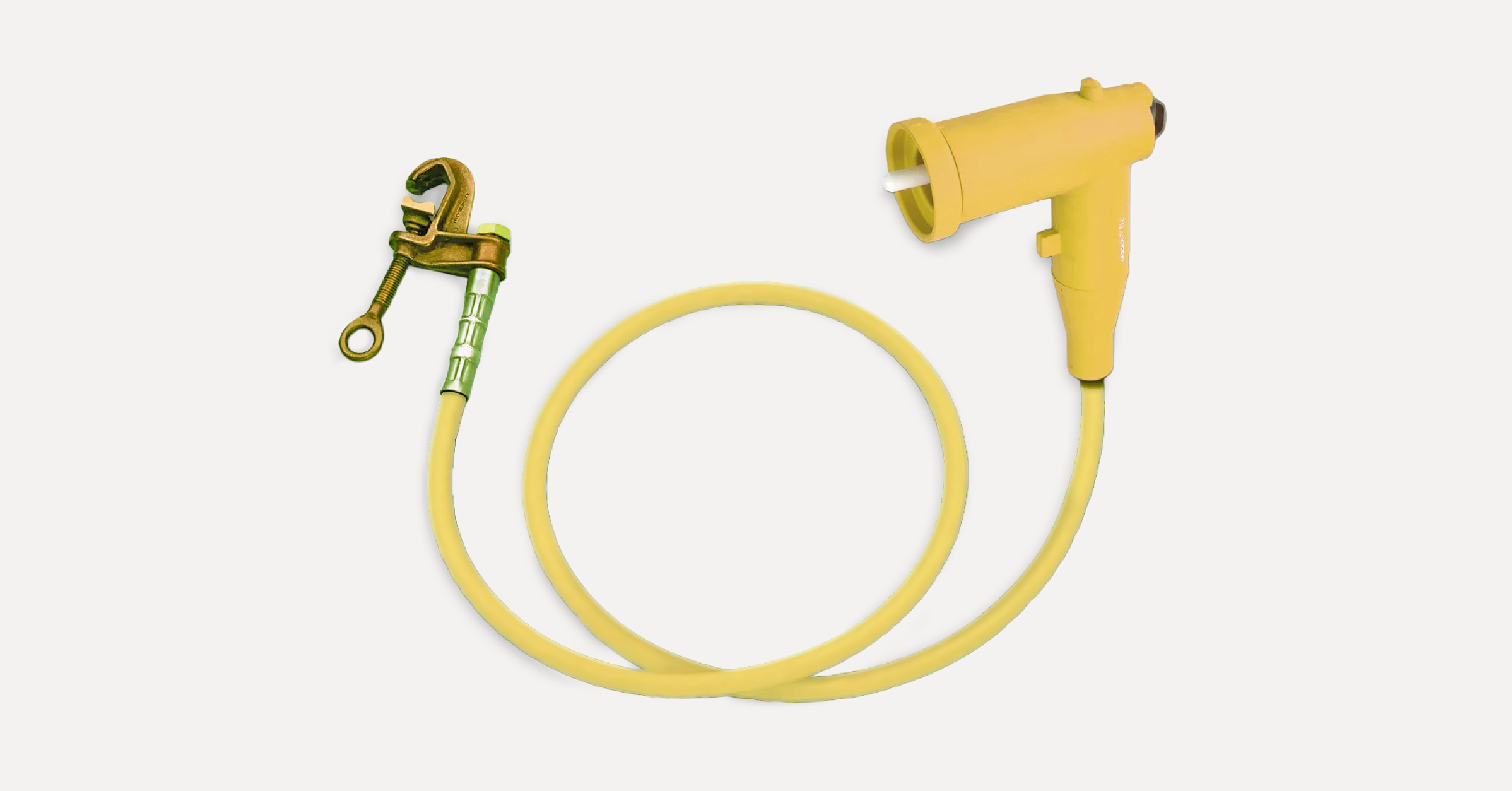
Misconception 1: 25 kV temporary grounding elbows will not work on 35 kV small interface bushings
-
25 kV and 35 kV small interface grounding bushings are dimensionally the same. The 35 kV small interface probe is slightly longer, but the 25 kV grounding elbow and probe will work for temporary grounding applications on 35 kV small interface systems.
-
The size of the elbow/bushing interface is listed as a voltage rather than a dimension. However, the voltage rating is not important as the temporary grounding elbows or parking stand bushings are used when the system is de-energized.
-
The fault current rating is what matters, not the voltage rating. The URD grounding elbows, parking stand bushings, and probes are rated and tested to 10 kA for 10 cycles per IEEE 386.
Misconception 2: I need to use 2/0 or 4/0 grounding cable with temporary grounding elbows and parking stand bushings
-
200-amp load break grounding elbows and parking stand bushings are rated for 10 kA for 10 cycles per IEEE 386.
-
The 1/0 grounding cable included with most URD ground sets is more than sufficient for 10 kA for 10 cycles as 1/0 grounding cable is rated and tested to 21 kA for 15 cycles per Table 1 of ASTM F855.
-
2/0 grounding cable will fit in our grounding elbows if desired, but it is unnecessary as the limiting factor for fault current rating of the 200-amp URD grounding sets is the capacity of the bushing insert and probe, not the size of the grounding cable.
-
4/0 grounding cable will not fit in the grounding elbows and cannot be used.
Misconception 3: I am protected when using 200-amp elbow grounding sets on 600- or 900-amp t-bodies.
The fault current rating for 600- and 900-amp t-bodies is 25 kA for 10 cycles. The rating on the 200-amp elbow is only 10 kA for 10 cycles and is not sufficient to protect against higher fault currents. 25 kA rated grounding equipment is available in the market and should be used when the available fault current is over 10 kA but only up to 25 kA for 10 cycles.
Misconception 4: I can use welding cable and tap clamps to build URD grounding sets.
Only rated and tested cable should be used to assemble temporary protective URD grounding sets. Welding cable is similar to grounding cable but should only be used if it meets the requirements of and has been fault current tested per the ASTM F855 and IEEE 386 standards.
Tap clamps should never be used. They are only rated for a small amount of continuous current. Tap clamps are not tested per the ASTM F855 and IEEE 386 standards and are not designed and capable of withstanding the thermal and mechanical forces generated by a fault current.
Temporary Protective Grounding Training
Proper temporary protective grounding requires specific knowledge and training. An excellent resource is the Chance Encyclopedia of Grounding. For questions on temporary protective grounding or to schedule training with a CHANCE expert, please reach out to your local Hubbell Power Systems Territory Manager or fill out this form.

.png?width=767&name=ACL-HPSUA-GR-EN-04290%20(1).png)