Streetlight Foundation Design: ASD vs. LRFD Explained
A technical comparison of ASD vs. LRFD streetlight foundation design per AASHTO, including wind loading, safety factors, and foundation sizing.
Streetlight foundations in North America have historically been designed using Allowable Stress Design (ASD) methods, primarily in accordance with the AASHTO Standard Specifications for Structural Supports for Highway Signs, Luminaires, and Traffic Signals (AASHTO LTS 2013). In recent years, many owners and agencies have transitioned to Load and Resistance Factor Design (LRFD), as implemented in the AASHTO LRFD Specifications for Structural Supports for Highway Signs, Luminaires, and Traffic Signals (AASHTO LRFD LTS 1 2015).
ASD and LRFD employ different:
-
-
Load Combinations
-
Wind Speed Bases
-
Safety Formats
-
Therefore, designs performed under one methodology are not directly interchangeable with the other. Understanding the differences between these two methodologies is essential to avoid overdesign, incorrect loading assumptions, and unnecessary construction costs. Following are key differences between the two specifications and their implications for streetlight foundation design.
ASD vs LRFD at a Glance
ASD (Allowable Strength Design): Evaluates performance at service level loads. Resistance is expressed as an allowable value, typically defined as the ultimate capacity divided by a factor of safety. These represent the loads the foundation is expected to experience during normal in-service conditions.
LRFD (Load and Resistance Factor Design): Evaluates performance at factored (strength level) loads. Loads are increased using load factors, while resistance is reduced using resistance factors (φ). These represent ultimate load effects used to check structural strength and reliability.
Key takeaway: Both ASD and LRFD are designed to achieve similar overall reliability, but they apply safety in fundamentally different ways. As a result, a load determined using ASD will not be the same as a load determined using LRFD.
|
Topic |
ASD |
LRFD |
|
Design Basis |
Service loads |
Factored loads |
|
Safety Method |
Factor of safety |
Load & resistance factors |
|
Wind Maps |
ASCE 7-05 |
ASCE 7-10 |
|
Typical Wind Speeds |
Lower |
Higher |
|
Design Philosophy |
Allowable stress |
Ultimate strength |
|
Serviceability Checks |
Implicit |
Explicit |
What changes most for streetlight foundation design
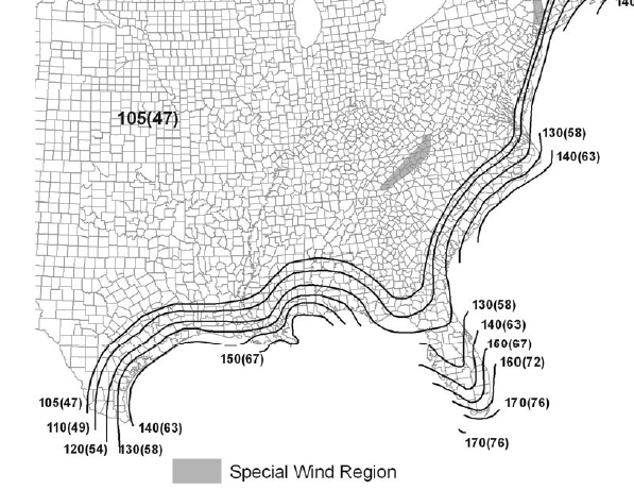
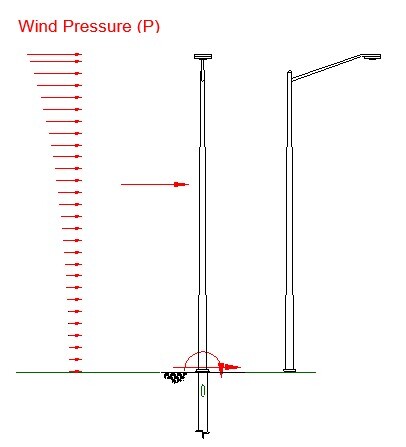
For typical light poles and luminaries, wind is the controlling load. When an owner specifies AASHTO LRFD LTS-1 instead of AASHTO LTS 2013, the design wind speed is the most noticeable difference. The reason for this change is the wind maps used. The LRFD specification references ASCE 7-10 wind maps based on 300-, 700-, or 1,700-year mean recurrence intervals, depending on structure importance classification.
Whereas the ASD uses the 50-year wind speed from ASCE 7-05 and a separate factor for importance adjustment. Because LRFD uses higher design wind speeds, the calculated wind loads are typically higher than those produced using ASD.
Service-Level vs Strength-Level Design
The differences in how LRFD and ASD loads are applied stem from the fundamental nature of the loading concepts used by each method. LRFD evaluates structural performance using factored (strength level) loads, with loads increased by load factors and resistance reduced using resistance factors (φ), where φ is limited to a maximum value of 1.0. This framework results in a “strength based” or “survival” design philosophy, where the foundation is intended to resist the calculated design loads, but not necessarily loads beyond that level. In addition to strength checks, the LRFD specification includes explicit serviceability requirements. This requirement states that for the wind loading corresponding to a 10 year mean recurrence interval, the pole deflection is limited to 2.5 percent of its overall height.
In contrast, ASD is based on working (service level) loads. These service loads are multiplied by a factor of safety to estimate the required ultimate capacity of the foundation. The applied factors of safety are intended to control both strength and serviceability, such that the pole remains functional and does not experience excessive deflection under normal loading conditions. Typical factors of safety range from approximately 2.0 for standard light poles to 3.0 for camera poles.
Why ASD and LRFD results are not directly interchangeable
These two design systems are not interchangeable. In practice, a foundation designed entirely using either ASD or LRFD will typically result in similar overall foundation dimensions. However, when the higher LRFD wind speeds are combined with an ASD factor of safety, the resulting foundation design becomes significantly larger than required by either specification alone. This outcome stems from a misunderstanding of how loads are defined and applied within each methodology. The critical question is whether the applied load represents a service level demand or a strength level design demand.
Important: Applying ASD safety factors to LRFD wind loads can significantly oversize foundations and increase project cost unnecessarily.
Information needed for an accurate foundation design
Hubbell is happy to provide a preliminary design for either method. However, since both are commonly used, please provide the design details up front. The most helpful items are listed on the Pole Load Determination Sheet (PLDS) and are listed below:
-
-
Governing standard and edition (e.g., AASHTO LTS 2013 vs AASHTO LRFD LTS-1 2015, or agency-specific requirements). The governing standard and edition will specify the Design Wind Speed
-
Pole configuration: mounting height, arm length, luminaire size, banners/signs, and any attachments that add projected area
-
Geotechnical information: soil classification and strength parameters, groundwater depth, and frost depth
-
Owner acceptance criteria: allowable deflection/rotation limits (if above/beyond spec requirements)
-
What you can expect from a Hubbell design
When the design basis is confirmed, Hubbell can provide foundation reactions and foundation design calculations consistent with the specified method (ASD or LRFD) in the form of a preliminary design. Preliminary designs will identify the applicable standard/edition, key assumptions (attachments, soil parameters, etc.), and resulting foundation loads.
If you are unsure whether your project should be treated as ASD or LRFD, Hubbell can also assist in determining the correct approach.
Simply fill out the Pole Load Determination Data Sheet and email it to our team at civilconstruction@hubbell.com.
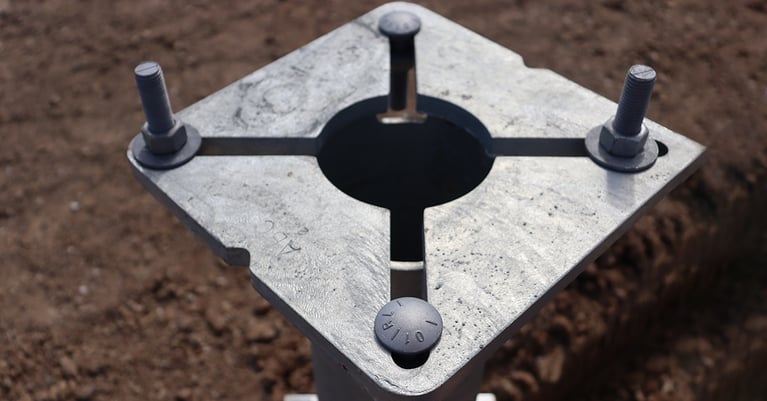
Learn more about Chance Instant Foundations - engineered, tested, and trusted since 1976.
Recommended Posts
Built to Last: Proven Longevity & Corrosion Resistance of Steel Foundations
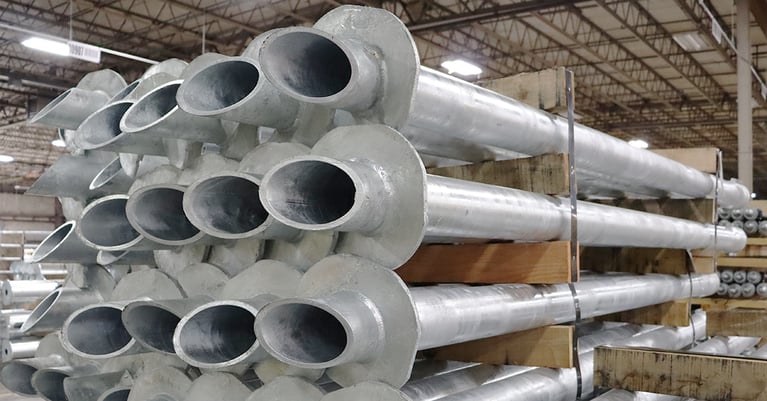
Going Solo: Load Improvement of Single-Helix Anchors and Piles