How Helix Count Affects Helical Pile Performance, Cost, & Installation
Optimize helical pile design by choosing the right helix count for soil, capacity, installation, and cost.
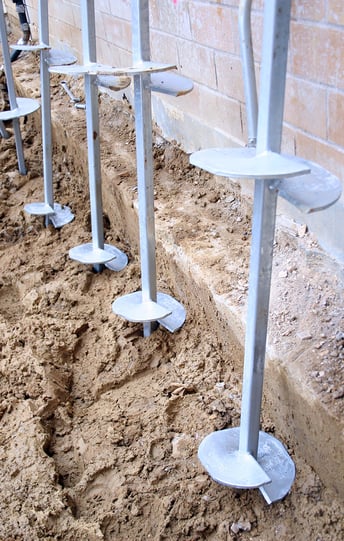
When designing a helical pile, it can be tempting to assume that more helices automatically mean more capacity. In practice, helix count is a design decision that affects far more than bearing area. Each additional helix can increase compression or tension capacity, but it can also raise installation torque, add fabrication cost, and create constructability challenges in dense or variable soils. To perform reliably, every helix must be properly spaced and positioned to contribute meaningful, independent bearing. When too many plates are added, the pile may encounter excessive resistance, reach premature refusal, or exceed the shaft’s torque limits before achieving the intended depth. In many cases, additional helices deliver diminishing returns, especially when the soil profile does not justify the extra bearing area. A maximum of six helices per pile is suggested as a practical limit in most soil conditions. More helices can actually reduce bearing capacity due to soil disturbance. The goal is not to use the most helices possible; it is to select the helix configuration that meets capacity requirements while supporting efficient, predictable installation.
When Fewer Helix Plates Improve the Design
Fewer helices can optimize a design when done thoughtfully. Reducing the number of helix plates can have benefits, including:
- Pile becomes easier to advance through varying soil layers
- Welding and fabrication requirements decrease – bringing down cost
- Possibility of torque overload is reduced
Many modern designs achieve the same or even greater performance by selecting the right combination of helix diameters and depth rather than stacking more plates onto the shaft. For example, replacing an 8–10–12 configuration with a 10–12 can result in deeper penetration into a bearing stratum before the installation torque rating is reached. Fewer helices mean faster production, lower cost, and less risk of refusal—especially in soils with gravel seams, cobbles, or dense sand lenses. The key is to recognize that each helix plate should contribute independent, meaningful load-bearing performance; if a plate adds cost without contributing much additional capacity because of soil conditions or interaction effects, it’s better to remove it and extend the pile deeper. Ultimately, the smartest helical pile designs don’t use the most helices—they use the right helices, in the right configuration, to achieve capacity efficiently and reliably.
 Why Soil Conditions Drive Helix Selection
The decision to add or subtract helices is also deeply connected to how the pile interacts with the soil profile. In soft/medium clay or loose/medium-dense sand, additional helices may be justified because they engage more surface area in soils that have lower shear strength. But in hard clay, dense sand, tills, or partially weathered rock, every added helix increases the risk of refusal or damaging torque spikes. Engineers must evaluate not just design capacity but installability—contractors need a configuration that will advance smoothly through the entire subsurface profile without issues. Sometimes, a two-helix pile will outperform a three-helix pile simply because it can penetrate into competent soil more reliably. This is why torque monitoring during installation is so important: it confirms that each helix is engaging the soil properly and ensures that the pile is not over-stressed while advancing. The industry’s best practice is to design for the load but install for the soil, and helix count is central to achieving that balance.
How Helix Count Impacts Project Cost
Beyond performance and installation, the economic implications of helix count are significant. Each helix adds material, welding, galvanizing, shipping weight, and installation time. For large projects with dozens or hundreds of piles, eliminating a single helix from each lead section can result in substantial savings without compromising structural integrity. Conversely, adding unnecessary helices at the design stage can inflate project costs for no real gain. Owners, engineers, and contractors increasingly look to torque correlation, soil testing, and field-proven configurations to guide helix selection rather than defaulting to “more is better.” When optimized thoughtfully, helix configuration becomes a powerful tool for controlling project budgets while ensuring reliable, repeatable foundation performance. The most cost‑efficient projects today are built around helix counts that are justified by soil mechanics and verified by installation data—not tradition or guesswork.
Some cases when more helices may be justified include when:
- Soil profile has low shear strength
- Design load is high
- Available embedment depth is limited
- Uplift capacity is needed
In these cases, additional helix plates can increase bearing area and help develop the required compression or tension capacity—provided each helix is properly spaced, positioned in suitable soil, and able to contribute independently.
Using HeliCAP® Helical Capacity Design Software to Compare Capacity and Cost
Engineers have access to decades of helical pile performance data on Chance products by utilizing the free design software, HeliCAP.
Here’s how it works. Click here for HeliCAP video tutorials
- Create an account and log in
- Input a soil profile into a new job
- Navigate to the User Load Tab at the top of the screen
- Input your design load and safety factor
- Select your pile configuration(s)
- Click “calculate” to compare the cost factor and capacity of your pile selections
- Click “insert” to select your pile and have it inserted into your soil profile
For example, in this soil profile, I am looking to achieve a design load of 35 kips in compression with a safety factor of 2. Thus, the required ultimate capacity is 70 kip.
In the “User Load” tab in HeliCAP, I selected an SS175 (1-3/4” square shaft helical pile). HeliCAP allows you to select multiple helix configurations and compare them. I chose a 2-helix, 3-helix, and 4-helix configurations as follows:
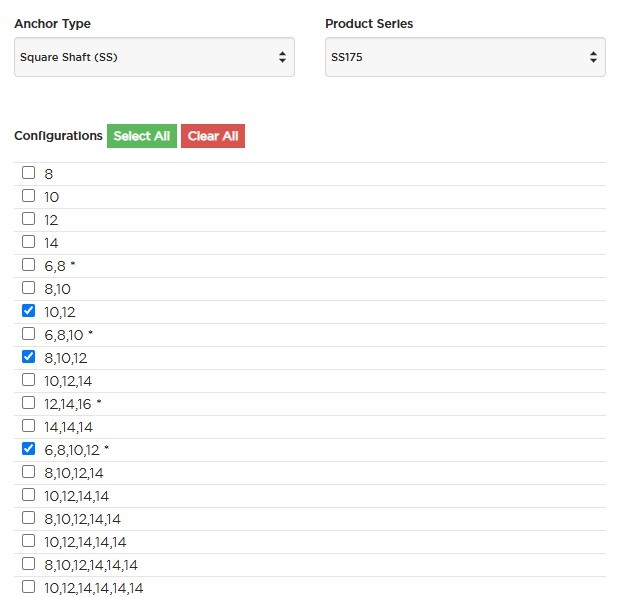
Next I click “calculate” and get the following results:
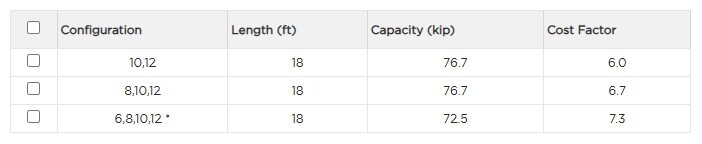
In order to meet my ultimate capacity requirement of 70 kip, the software calculated that I need an 18-foot pile in all three cases. Looking at the capacity column, you can see that all three configurations meet the requirement (which is what HeliCAP is designed to do). However, the last column, cost factor shows us that the two-helix (10”-12”) configuration gives us the lowest cost factor, meaning the “best deal” for the capacity. Given the installation advantages of fewer helices as discussed above, it will likely be in the best interest of the project to select the two-helix lead section.
Conclusion
When it comes to helical pile design, the best solution is rarely the one with the most and largest helices—it is the one that delivers the required capacity efficiently, installs reliably, and makes sense for the actual soil conditions. Adding helix plates can increase bearing area, but it can also raise torque demand, increase cost, and create installation challenges. Reducing helix count, when supported by soil data and capacity calculations, can often improve constructability and lower project costs without sacrificing performance. Tools like HeliCAP help engineers compare configurations, evaluate capacity, and make informed decisions based on both design requirements and field practicality. By selecting the right helix combination instead of simply adding more plates, project teams can achieve safer, more economical, and more predictable foundation performance.
Ready to optimize your next helical pile design?
Use HeliCAP to compare pile configurations, evaluate capacity, and identify cost-effective options for your soil profile and design loads. For additional support, contact your Chance Foundation Solutions representative to discuss the best helical pile configuration for your project.
Recommended Posts
Built to Last: Proven Longevity & Corrosion Resistance of Steel Foundations
Going Solo: Load Improvement of Single-Helix Anchors and Piles